CCW Orlando | January 2026
Santosh Subramanyam Q&A
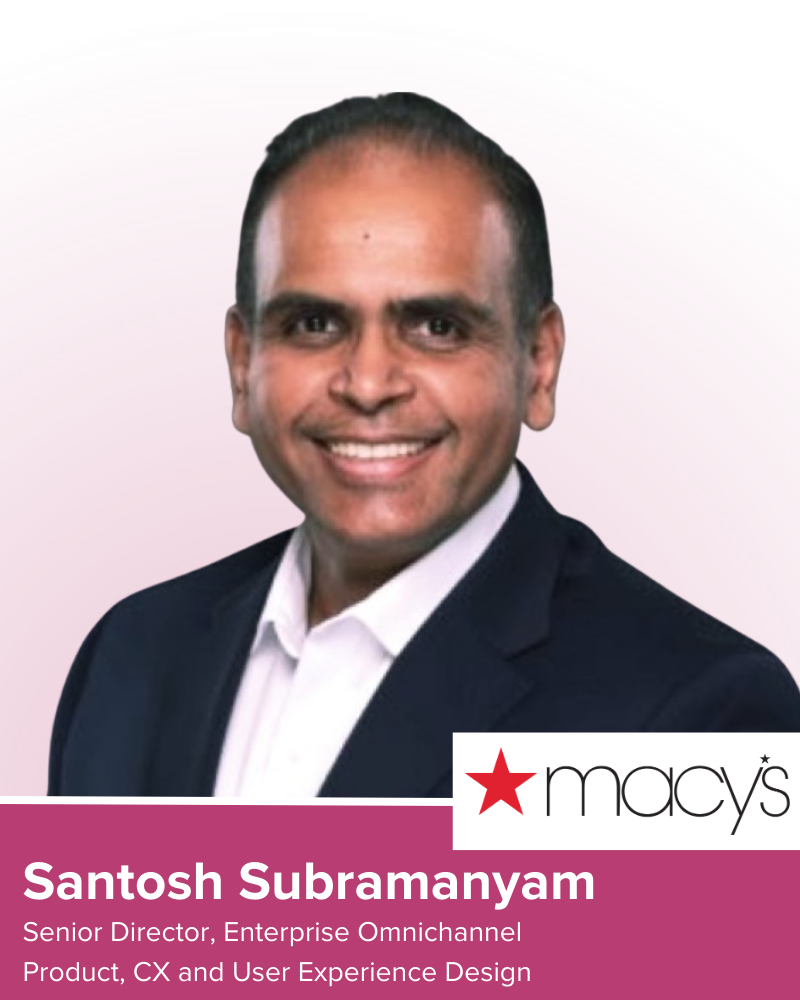
Santosh Subramanyam is a Product & CX Design Leader who turns complex, multi-billion-dollar ecosystems into friction-free experiences that delight customers and move the P&L. With 15+ years of experience spanning retail, hospitality, automotive, higher-ed and technology, he bridges strategy, design, and data to deliver measurable impact at scale.
At Macy’s, Santosh leads enterprise design strategy across stores, digital, supply chain, media and marketplace platforms, driving transformation through AI-powered experiences, connected journeys, and scalable design systems.
His work focuses on turning vision into velocity, building and maturing design organizations that balance craft with business outcomes; insight into revenue, leveraging research and AI to uncover loyalty and growth opportunities; and ambiguity into advantage, thriving in high-stakes, high-impact transformations.
A keynote speaker, TAG CX Society board member, and lifelong mentor, Santosh is passionate about advancing design literacy, shaping next-gen leaders, and creating human-centered innovation at scale.
AC: You’ve described AI as a catalyst for call center agents rather than a replacement. What early indicators have you seen that show AI truly improves agent effectiveness and customer outcomes?
Santosh: After using the new AI feature, agents repeatedly say, “I finally feel like I can focus on the customer again.”
We are still finetuning the solution, but initial signals point to three areas:
Cognitive load reduction: Agents aren’t hunting for information across 9 different systems. AI surfaces the next best action, policy details, and conversation summaries in real time through a single pane of glass.
Confidence + consistency: New agents onboard faster and escalate less with the instant expert-level knowledge AI provides.
Customer-facing outcomes: Shorter handle times are a by-product, not the goal. More importantly, conversations are more likely to resolve with one contact and result in higher customer satisfaction because agents have the mental space to connect, empathize, and guide.
When agents tell us, “I feel more supported and less stressed,” we know we’re on the right path.
AC: How do you determine which points in the customer journey are strongest candidates for AI enhancement and which should remain human-led?
Santosh: We look for a few important signals:
Repetition + high cognitive load
Tasks that are frequent, rules-based or involve sifting through voluminous data are in AI’s wheelhouse
Moments of emotion or trust-building
Moments requiring reassurance, negotiations, or empathy remain human led. AI can support, but not replace, the relationship.
Journey breakpoints
Anywhere a customer must navigate complexity (returns, billing issues, cancellations), AI becomes an orchestrator by guiding both the customer and the colleague, not taking over the moment.
We don’t ask, “Where can AI replace humans?”
We ask, “Where can AI remove friction so humans can show up at their best?”
AC: How do you ensure that human empathy and hospitality-centered approaches remain central as more AI-driven workflows are introduced across the omnichannel experience?
Santosh: We start by designing AI around humans, not the other way around:
Human-in-the-loop from day one:
Agents, store colleagues, and customer care experts co-design solutions, prompts, flows, and guardrails with us.
Emotional checkpoints:
‘”Pause points” are built into agentic workflows to account for human judgment calls, which allows for empathy and emotion to come into play.
AI as a hospitality amplifier:
Instead of scripting empathy, AI clears the cognitive clutter so empathy can happen naturally, more eye contact in stores, more listening over the phone, more follow-through online.
The principle is simple: AI handles the tasks; humans handle the care.
AC: With such a broad portfolio, from supply chain to store ops to mobile apps, where have you seen AI produce the most surprising or unexpected impact across the enterprise?
Santosh: We explore AI-driven workflows that enhance hospitality without losing the human touch. The biggest impact has been on our colleague-facing solutions.
Real-time sentiment analysis gives agents instant coaching, prompting them to slow down, acknowledge frustration, or try a new approach. According to agent feedback, It’s like having a non-judgmental coach at their desk.
In addition, the same methodology enables us to orchestrate store operations. This gives our store colleagues an AI assisted solution to look up inventory, access product information or guide troubleshooting. The result is reduced friction for colleagues, especially with newer hires.
AC: Can you share a bit about the “Future of Store” initiative and how it’s shaping your view on the next generation of in-store experiences for customers and colleagues?
Santosh: The Future of Store initiative is our North Star for what an AI-enabled, hospitality-driven retail environment should look like.
A few pillars that are shaping the next decade:
Phygital journeys:
AI helps us coordinate tasks, identify risks, and prioritize what matters so colleagues can focus on serving customers.
Agentic store operations:
AI is here to help us coordinate tasks, identifies risks, and helps colleagues prioritize what truly matters focusing on serving the customer
Adaptive experiences:
The experience dynamically shifts based on context: heavy floor traffic, low staffing, high-demand categories, or even seasonal shifts.
Most importantly, the Future of Store isn’t about futuristic tech—it’s about giving colleagues the power to offer hospitality at scale.
AC: You’re presenting a framework for aligning AI to customer journeys at CCW Orlando. What was the biggest lesson or challenge your team encountered while developing that approach?
Santosh: This work is in progress—and intentionally so. As customer behaviors and sentiment shift, we’re constantly refining how we build tech experiences that feel intuitive, trustworthy, and human.
One guiding principle anchors everything we do:
“AI is not a feature — it’s an ecosystem.”
That means our real challenge isn’t “Where can we add AI?”
It’s “How should AI behave across an end-to-end journey so that people always understand it, feel in control, and trust it?”
To get there, we’re building:
- A shared language across product, design, tech, and data
- Guardrails that protect safety while fostering empathy and hospitality
- Service-blueprint clarity that prevents inconsistencies and unintended downstream consequences
This work requires us to unlearn old patterns and pivot from designing interfaces to orchestrating systems.
To move from static interactions to agentic behavior that adapts, reasons, and supports better outcomes for customers and colleagues.
And we’re doing it together, one discovery, one insight, and one journey at a time.
AC: Finally, what mindset or cultural shifts are necessary within an organization before AI can successfully transform customer and colleague experiences in the ways you’ve described?
Santosh: My view is simple: AI can’t succeed until the organization shifts—culturally and operationally. Three mindset changes matter most:
1. From automation to augmentation.
If you build to replace people, you create fear.
If you build to empower people, you create trust—and adoption.
2.From project thinking to journey thinking.
AI doesn’t live in a single feature.
It lives in the transitions: between agents, systems, stores, and digital channels.
3.From fear to experimentation.
Teams need the space to ask:
• What if we tried…?
• What can AI take off our plate?
• How does this make life better for colleagues first?
The organizations winning with AI aren’t the ones with the most models. They’re the ones with the most curiosity, humility, and empathy.